What Is Shadow Testing? Four Ways to Bulletproof Your APIs
Shadow testing runs a new version of a service alongside the current one in an isolated pre-production sandbox, sends both the same representative traffic, and compares the responses, so you catch API contract breaks, performance regressions, hidden log patterns, and security issues before they reach production. This guide covers four things shadow testing unlocks, how it differs from canary releases and feature flags, and why it is becoming the way AI coding agents validate their changes in isolation on a shared cluster.
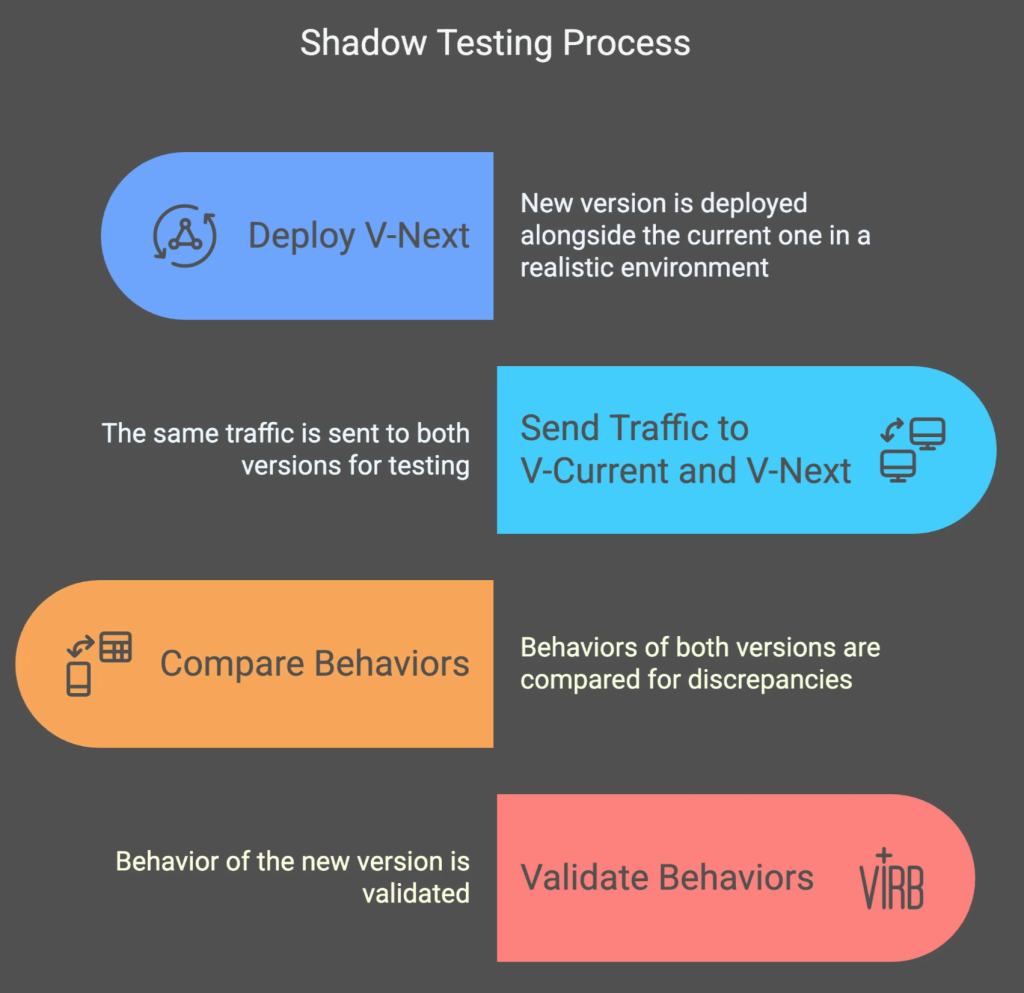
Shadow testing means running a new version of a service alongside the current version in an isolated pre-production environment, sending both the same representative traffic, and comparing their responses to catch regressions before release. No real user ever sees the unreleased version, which is what makes it safe to test changes that would be too risky to canary.
I’ve spent the last 20+ years building distributed systems, and one truth remains constant: microservices testing is challenging. Shadow testing is a powerful approach to validate microservice changes safely because engineering leaders are eager for better ways to test complex microservice architectures.
Before getting into what shadow testing unlocks, it is worth being precise about what it is, and what it is not. Shadow testing covers what a contract cannot, and the complete guide to contract testing explains where that boundary sits.
What Is Shadow Testing?
The detail that matters most for everything below is where this runs. Shadow testing happens in an isolated, pre-production sandbox, not against live production. The “same traffic” sent to both versions is usually synthetic or replayed requests crafted to closely mimic real conditions, routed to an isolated copy of the changed service running against the shared baseline. The closer that representative traffic is to the real thing, the more useful the result, but no real user is ever in the loop.
Shadow Testing vs. Canary Releases and Feature Flags
That is what separates shadow testing from two approaches it often gets confused with:
- Canary releases roll a change out to a small slice of real users and watch for problems. Failures still reach those users. Shadow testing runs before anyone sees the change.
- Feature flags turn functionality on and off at runtime. They are useful for controlled rollouts, but they sit late in the lifecycle and do not give you a clean comparison of old behavior against new.
Shadow testing is a shift-left technique: it catches regressions, contract breaks, and performance issues early, inside a sandbox, without the brittleness of hand-maintained integration tests.
The real magic happens when we leverage this parallel execution to derive actionable insights that traditional testing methods simply can’t provide. Let’s explore four powerful testing approaches that shadow testing enables, each providing unique signals that help developers ship with confidence.
1. API Contract Testing: Detecting Breaking Changes
API contract testing is perhaps the most immediately valuable application of shadow testing. Traditional contract testing relies on mock services and schema validation, which can miss subtle compatibility issues. Shadow testing takes contract validation to the next level by comparing actual API responses between versions.
Here’s how it works:
- Deploy your updated service alongside the baseline version.
- Route identical traffic to both versions.
- Compare the responses in real time.
- Identify any divergence that indicates potential contract breaks.
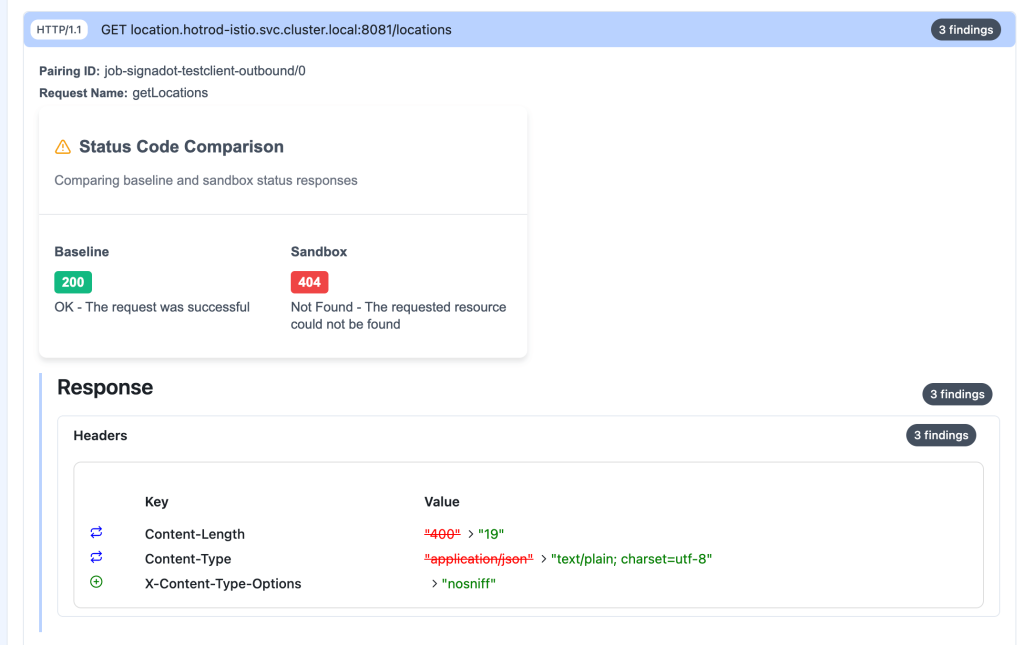
This approach catches breaking changes that would be invisible to conventional testing: field type changes, new required fields, altered error responses and even performance degradation that might violate service-level agreements (SLAs).
This approach combines the best of specification-based contract testing with runtime validation. Rather than just checking if your new API implementation conforms to a static specification, you’re directly measuring compatibility with everything currently consuming it.
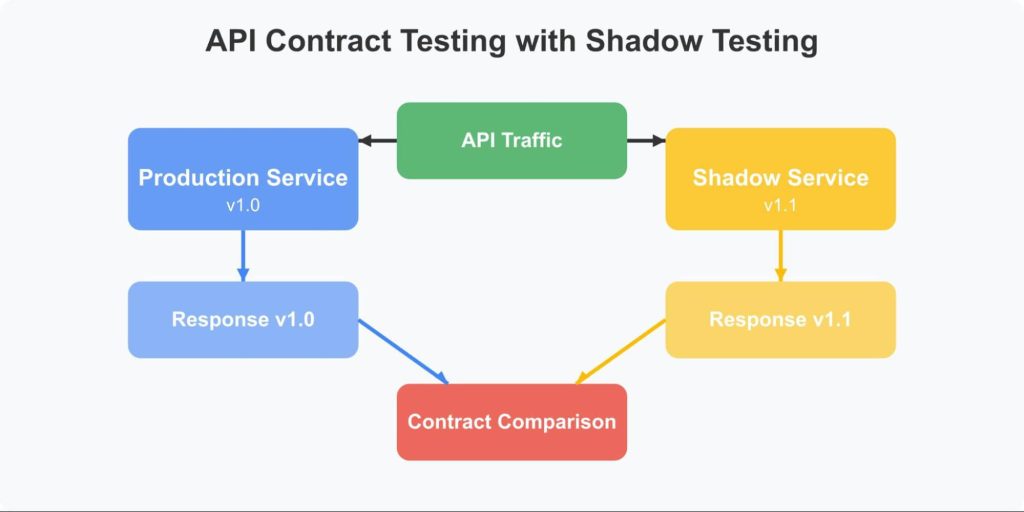
For instance, when a team at a fintech company implemented this approach, it caught a subtle breaking change where a field was being converted from string to integer, something its OpenAPI validators hadn’t flagged, but that would have broken several downstream consumers. The shadow testing system highlighted the discrepancy immediately, allowing the team to fix it before merging.
2. Performance Testing: Compare Side by Side
Performance testing is another area where shadow testing shines. Traditional performance testing usually happens late in the development cycle in dedicated environments with synthetic loads that often don’t reflect real-world usage patterns.
With shadow testing, you can:
- Run your new code against realistic, production-like traffic patterns.
- Compare key metrics against the baseline version in real time.
- Identify performance regressions before they affect users.
- Validate that optimizations actually deliver expected improvements.
This approach is particularly powerful when combined with canary analysis tools like Kayenta, which can automatically analyze statistical significance in performance differences.
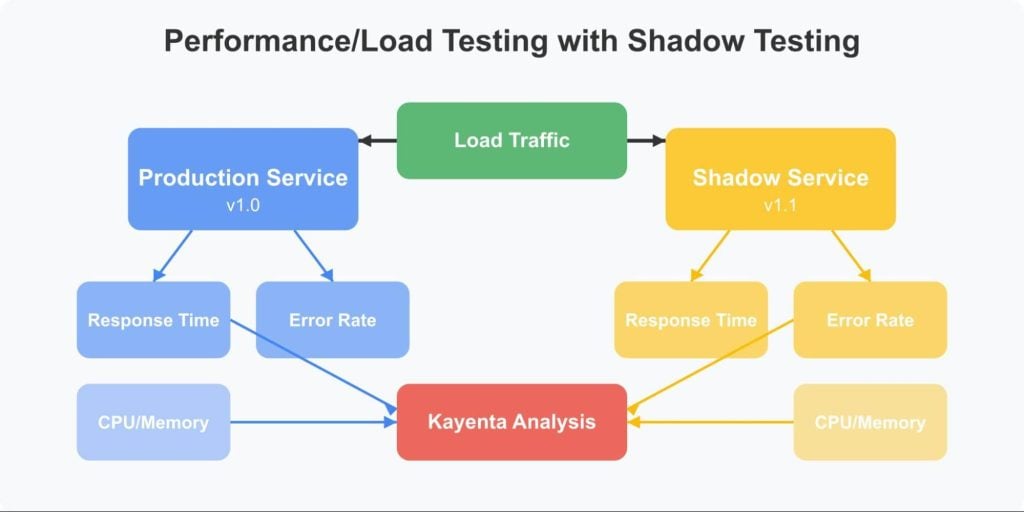
A retail platform I worked with used this approach to validate a major database query optimization. While its synthetic benchmarks showed a 40% improvement, shadow testing against real traffic revealed edge cases where certain user queries were performing worse. The team was able to address these issues before deploying, avoiding what would have been a serious production incident during the company’s peak shopping season.
The beauty of this approach is that it doesn’t just test whether your code functions correctly, it tests whether it functions correctly under real-world conditions with diverse traffic patterns that would be nearly impossible to simulate accurately.
3. Log Analysis: Uncovering Hidden Issues
Log analysis is often overlooked in traditional testing approaches, yet logs contain rich information about application behavior. Shadow testing enables sophisticated log comparisons that can surface subtle issues before they manifest as user-facing problems.
With log-based shadow testing, you can:
- Capture logs from both baseline and test versions.
- Apply machine learning (ML) clustering to identify new or changed log patterns.
- Highlight potentially problematic log sequences.
- Discover errors, warnings or unexpected behaviors that might not trigger test failures.
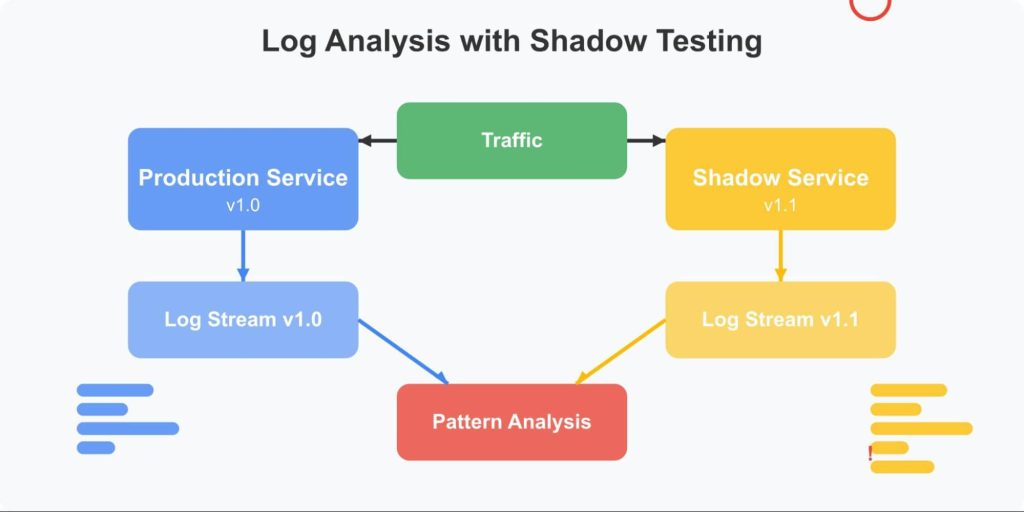
I’ve seen this approach catch issues that would have slipped through every other testing layer. One engineering team discovered their new code was generating a cluster of database connection warnings that weren’t present in the baseline version. While these warnings didn’t cause immediate failures, they were an early indicator of connection pool exhaustion that would have eventually led to cascading timeouts under load.
This approach bridges testing and observability, creating a feedback loop that helps developers understand the operational impact of their changes before deployment.
4. API Security Analysis: Shift-Left Security Validation
Perhaps the most innovative application of shadow testing is in the security domain. Traditional security testing often happens too late in the development process, after code has already been deployed. Shadow testing enables a true shift left for security by enabling dynamic analysis against real traffic patterns.
The approach works like this:
- Deploy your service changes to a sandbox environment.
- Run security scanning tools like OWASP ZAP against the sandboxed version.
- Identify and fix security vulnerabilities before merging your code.
- Prevent security issues from reaching production in the first place.
Signadot spins up isolated sandboxes on the Kubernetes cluster you already run, so every change is validated against real services before it merges. The free tier is open to every developer.
Runtime Security Analysis With Shadow Testing
Zed Attack Proxy (ZAP) is an open source security tool that acts as a “man-in-the-middle” proxy, intercepting and inspecting messages between client and server. It automatically scans for security vulnerabilities by analyzing responses and simulating attacks to discover weaknesses like SQL injection, cross-site scripting and authentication flaws.
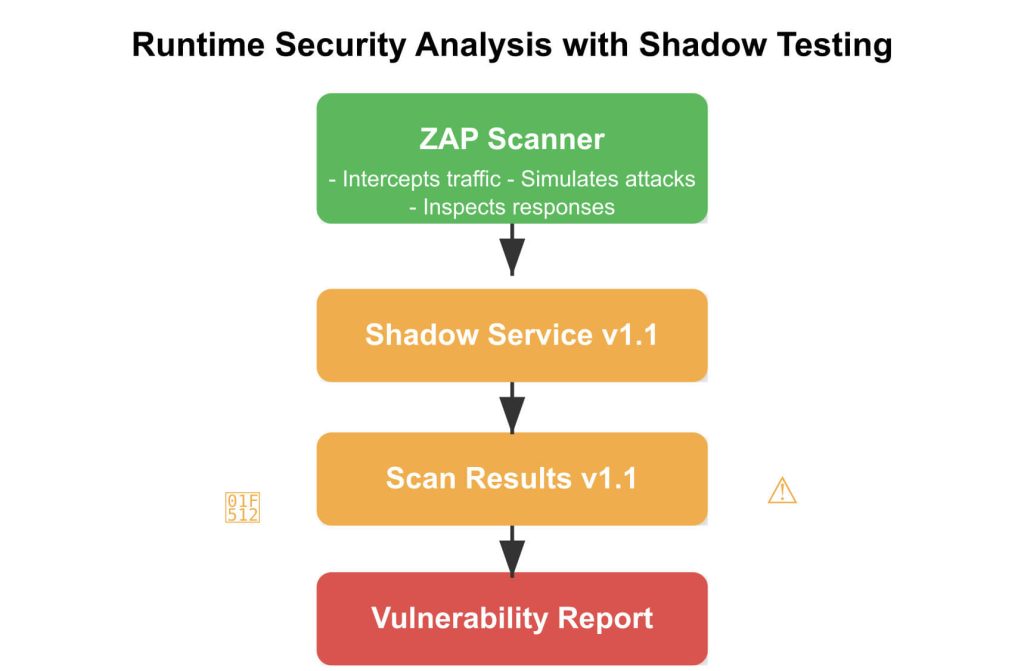
This approach is particularly powerful for detecting issues like new API endpoints that might be missing authentication checks, input validation flaws or information disclosure vulnerabilities, all before your code gets merged.
Automated security testing embedded in CI/CD pipelines has moved from a differentiator to table stakes, and shadow testing provides an ideal framework for this kind of automated security validation.
By integrating security scanning directly into your pre-merge testing workflow, you catch vulnerabilities during development when they’re easiest and cheapest to fix. This eliminates the traditional security bottleneck where issues are discovered late in the development cycle, requiring costly rework and delaying releases.
Self-Maintaining Tests: Automatic Pattern Detection
What makes these shadow testing approaches particularly valuable is their inherently low-maintenance nature. Unlike traditional testing approaches that require constantly updating test suites, mocks and assertions, shadow testing uses representative traffic and automated comparisons to detect issues with minimal human intervention.
The power lies in the baseline comparison: by running both versions side by side and automatically identifying differences in behavior, these tests essentially write themselves. They can detect subtle issues, emerging patterns and regressions without requiring engineers to anticipate every possible edge case.
This fundamentally changes the testing paradigm. Instead of spending countless hours maintaining brittle test fixtures, teams can focus on building features while automated differential analysis provides the safety net.
The pioneers of microservices at companies like Netflix and Uber have been using variations of these techniques for years. The difference now is that modern tools are making these low-maintenance, high-signal testing approaches accessible to engineering teams of all sizes.
How shadow testing works in practice
The mechanics are the same wherever you run it, and the pattern was pioneered by tools like Diffy, built at Twitter to test services by comparing responses instead of writing assertions. Three things happen:
- Traffic execution. The new version (V-Next) runs alongside the current version (V-Current), and both receive the same requests. That gives you a direct, apples-to-apples comparison of behavior.
- Response comparison. Outputs are captured and diffed to surface regressions. A good implementation uses a relevancy model to decide which differences matter and which are benign noise, like timestamps or reordered fields, so you are not buried in false positives.
- Observability and metrics. Performance and error patterns from both versions are analyzed to confirm the change is stable before it goes any further.
As Microsoft’s Engineering Fundamentals Playbook describes it, shadow testing captures the differences between the current environment and a candidate environment, then reduces risk before you introduce the new release.
Where Do You Run Shadow Testing: Staging or Production?
Where you run it is a choice. Staging shadow testing is easier to set up, sidesteps compliance and data-isolation concerns, and uses synthetic or anonymized traffic. Production shadow testing gives the most accurate signal from live traffic but needs real safeguards for data handling and workload isolation. For most teams an isolated sandbox on a shared pre-production cluster hits the sweet spot.
That is exactly what SmartTests are in Signadot. Shadow testing is the technique; a SmartTest is that technique packaged as a runnable test. Each run spins up an isolated sandbox for a branch, sends representative traffic to the changed service alongside the baseline, and compares request and response behavior in real time, using a relevancy model to separate meaningful regressions from benign noise. There are no assertions to write and no mocks to maintain, and it runs in Kubernetes with Istio, Linkerd, or no service mesh at all.
Why this matters more now that agents write the code
A growing share of code is now written by AI coding agents like Claude Code, Codex, and Cursor, and they produce changes far faster than anyone can hand-review them. Writing the change is no longer the hard part. Knowing whether it is safe to merge is. That is exactly the signal shadow testing produces.
Shadow testing also fits how agents work better than almost any other method, because it needs no hand-written assertions. The agent makes a change, its version is deployed into an isolated sandbox on the shared cluster, the same representative requests are sent to both the agent’s version and the baseline, and the differences are compared automatically. The agent does not have to anticipate every edge case or maintain a brittle suite. It gets a direct, behavioral answer: here is what your change does differently, and whether that difference is a regression.
The isolation is what makes this work at agent speed. Each change is tested against the real, shared baseline without standing up a full environment of its own and without colliding with the other agents and developers doing the same thing. Many changes can be validated in parallel on a single cluster. This is the same request-level isolation behind ephemeral environments on Kubernetes, applied to differential testing.
In Signadot this is delivered through SmartTests, which let an agent kick off a shadow comparison the same way it runs any other test. Paired with Jobs and Plans, an agent can run the comparison, read the result, and decide whether its change is ready, all before it opens a pull request. For the wider picture, see validating AI-generated code on Kubernetes.
Conclusion
Shadow testing is unlocking a new generation of testing approaches that provide deeper insights and more confidence than traditional methods. By detecting API contract issues, performance regressions, suspicious log patterns and security vulnerabilities before they reach production, teams can ship faster with greater confidence.
If you’re interested in exploring how shadow testing could transform your microservices testing strategy, I’d love to continue the conversation. Check us out at signadot.com or join our community discussions.
The future of microservices testing isn’t just about running more tests earlier, it’s about getting better signals that truly predict production behavior. Shadow testing is leading this evolution, proving that with the right approach, we can have both speed and quality.
Frequently asked questions
What is shadow testing?
Shadow testing runs a new version of a service alongside the current version in an isolated pre-production sandbox, sends both the same representative traffic, and compares their responses to catch contract breaks, performance regressions, and other issues before release.
Is shadow testing done in production?
Usually not. Shadow testing typically runs in an isolated pre-production sandbox using synthetic or replayed traffic that closely mimics real conditions. Some teams mirror live production traffic into a shadow copy, but that requires strict safeguards for data handling, and no real user ever receives a response from the unreleased version.
What is the difference between shadow testing and a canary release?
A canary release rolls a change out to a small slice of real users, so failures still reach those users. Shadow testing compares the new version against the baseline on the same traffic before any user sees the change, making it a shift-left technique rather than a rollout strategy.
How do Signadot SmartTests relate to shadow testing?
SmartTests are shadow testing packaged as a runnable test primitive. Each run spins up an isolated sandbox, sends representative traffic to the changed service alongside the baseline, and uses a relevancy model to surface meaningful differences. AI coding agents use them to validate changes automatically before opening a pull request.