
Complete guide to microservices testing environments on Kubernetes. Learn best practices for ephemeral environments and sandboxes. Read the guide.
In the world of cloud-native engineering, the staging environment is often where developer velocity goes to die. For engineering leaders and platform teams, the phrase “staging is down again” has become a painful, all-too-common refrain. It signals the start of another productivity-killing investigation that grinds pull request reviews, CI/CD pipelines, and feature delivery to a halt.
This isn’t a new problem, but its scale and cost have been magnified by the very architecture designed to speed us up: microservices. The promise of microservices was team autonomy and independent, rapid deployments. The reality for many scaling organizations is a shared staging environment that has become a central bottleneck, creating a state of constant resource contention and instability.1 When multiple teams deploy concurrent, unstable features into the same shared space, a single test failure triggers a time-consuming forensic exercise. Was it my change? Was it another team’s deployment? Or is the environment itself in a broken state?
A growing share of code is now written by AI coding agents like Claude Code, Codex, and Cursor, and they produce changes far faster than teams can review or test them. That shifts where the work piles up. Writing the change is no longer the hard part; validating it is. For cloud-native applications, validation has always run into the environment problem, and now the queue feeding that environment is much longer. The staging bottleneck stops being an occasional annoyance and becomes the rate limiter on the whole organization.
This uncertainty erodes developer confidence and slows the entire delivery pipeline. In fact, the problem of slow, inefficient testing is not just a frustration; it’s a multi-million dollar drain on resources. One VP of Platform Engineering recently calculated their “broken testing process” was costing them half a million dollars monthly in lost productivity.
This guide provides a strategic framework for engineering leaders and platform teams to navigate this challenge. We will explore the evolution of testing environments, from the inherent flaws of the traditional staging model to the rise of modern ephemeral environments. We will conduct a deep, balanced analysis of the two dominant architectural models for these environments, present a clear-eyed view of the ROI, and offer a path forward that aligns with the principles of high-velocity, cost-efficient, and scalable software development. For the full lifecycle picture, see our complete guide to microservices testing.
The traditional, long-lived staging environment was born in a simpler, monolithic era. It was a single, stable pre-production replica where final integration testing could occur. However, when applied to a complex microservices ecosystem running on Kubernetes, this model fundamentally breaks down.
As Kelsey Hightower, a prominent voice in the cloud-native community, has often noted, the goal of modern platforms should be to enhance the developer experience, yet traditional staging frequently does the opposite.3 It becomes a source of friction, not empowerment.
The core issues are systemic:
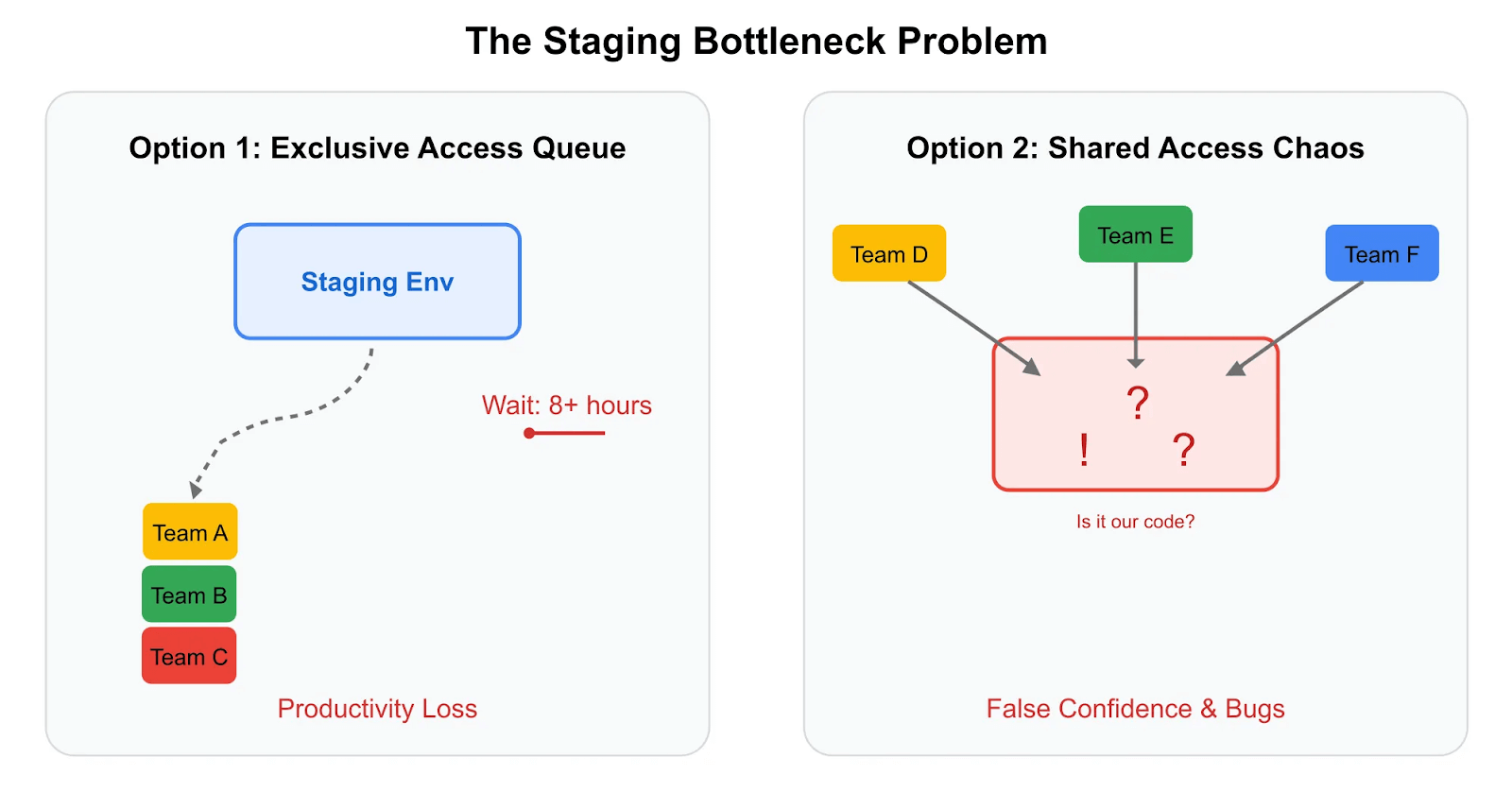
In response to these limitations, the industry has shifted towards a more dynamic paradigm: ephemeral environments. An ephemeral environment is an on-demand, isolated, and temporary deployment created automatically for a specific, short-term purpose, such as testing a pull request.
Unlike their static predecessors, these environments are treated as disposable components of the development workflow. They are provisioned when a PR is opened and automatically destroyed upon merge or closure, ensuring a clean slate for every set of changes and conserving infrastructure resources. This approach aligns with the “shift-left” philosophy of catching issues earlier in the development lifecycle, when they are exponentially cheaper to fix.
The core attributes of a well-architected ephemeral environment system are:
While the concept is powerful, the implementation strategy is where the paths diverge, with profound implications for cost, speed, and scalability.
The most conceptually straightforward approach is to duplicate the entire application stack for every pull request. This typically involves creating a new Kubernetes namespace and deploying all microservices and their dependencies into it. Tools like Okteto and Release are often associated with this philosophy of providing complete, replicated environments.
Strengths:
Weaknesses and Business Impact:
The simplicity of this model hides crippling inefficiencies that become apparent at scale.
While full duplication appears to solve the problem of contention, it often backfires at scale, creating a distributed version of the same bottlenecks and adding an unsustainable financial and operational tax. As one developer on Reddit noted after attempting this approach, “It eventually worked, but took a very very long time… and also had a high operational overhead. It also got very expensive, very quickly”.
A fundamentally different and more cloud-native approach is to achieve isolation at the application layer through intelligent request routing. This model, pioneered by tech giants like Uber and Lyft and commercialized by platforms like Signadot, is built on a shared infrastructure paradigm.
The architecture works as follows:
Strengths and Business Impact:
This innovative architecture yields a set of powerful benefits that directly address the primary pain points of other models.
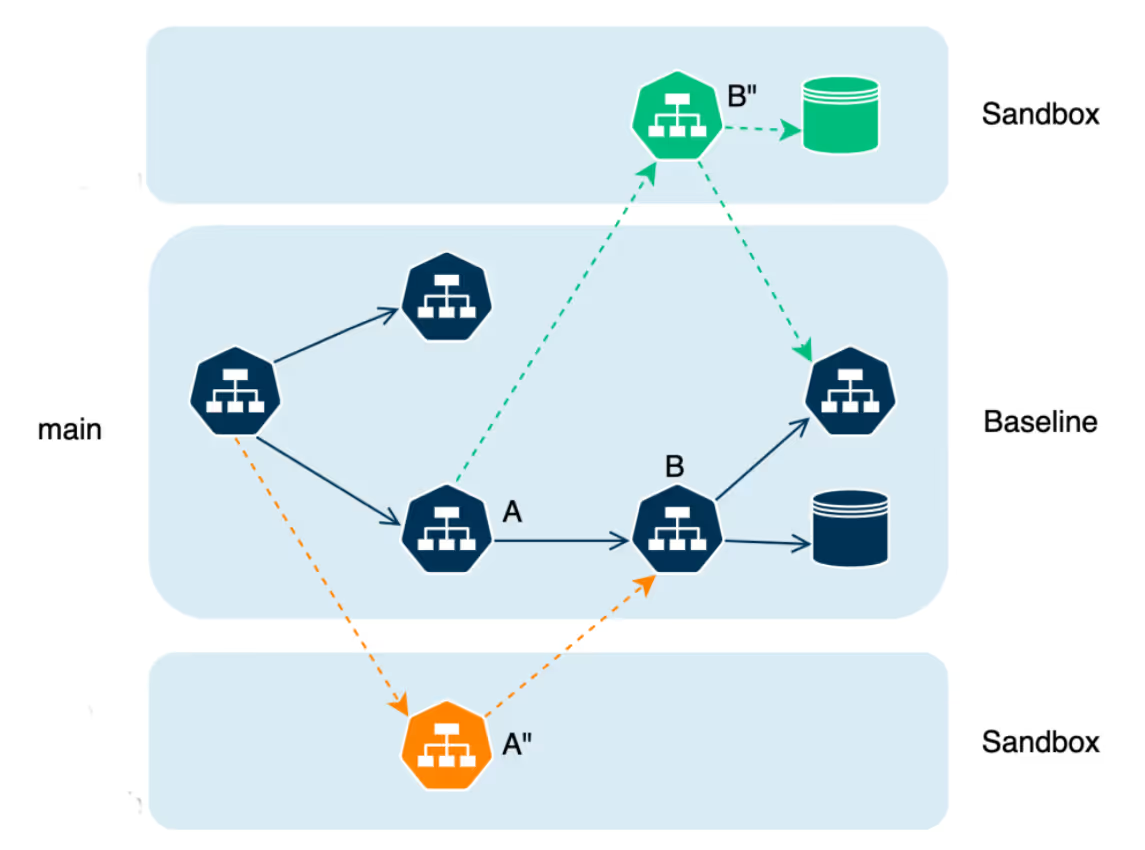
These same properties are what make the model a good fit for AI coding agents. An agent does its best work when it can close the loop on its own: make a change, run it against real dependencies, read the result, fix, and repeat, without waiting on a human or queuing for a shared environment. That requires environments that are cheap and quick to create but still high fidelity, which is exactly the combination request-level isolation provides. A sandbox gives an agent an isolated place to exercise its change, and a validation layer on top, covering functional and non-functional checks of AI-generated code, tells it whether the change is actually safe to ship.
For engineering leaders, the decision to invest in a testing platform must be justified by a clear return on investment. The business case for request-level isolation is compelling, with measurable improvements across cost, velocity, and quality.
The DORA (DevOps Research and Assessment) metrics are the industry standard for measuring software delivery performance. An effective testing environment strategy should directly and positively impact these key indicators.
Beyond hard metrics, the impact as stated in this article is profound. As articulated in a recent ACM Queue article, the three pillars of a great DevEx are short feedback loops, low cognitive load, and enabling a “flow state”. Traditional testing models actively work against all three.
In contrast, a seamless, fast, and reliable testing environment is a strategic asset for attracting and retaining top engineering talent. As one Software Engineering Manager at Brex, Connor Braa, put it, “On the margin, with the Signadot approach, 99.8% of the isolated environment’s infrastructure costs look wasteful. That percentage looks like an exaggeration, but it’s really not”. This level of efficiency directly translates to a better daily experience for developers, allowing them to focus on creative problem-solving instead of fighting with broken infrastructure.
A common and valid question about the shared infrastructure model is how it handles stateful services and asynchronous workflows. A mature request-level isolation platform must provide robust solutions for these complex scenarios through a principle of tunable isolation: each stateful component gets only as much isolation as the test actually needs.
The evolution of testing environments for microservices reflects the maturation of the cloud-native ecosystem. We have moved from the brittle, monolithic staging environments of the past to a new era of dynamic, on-demand testing.
However, as we’ve seen, not all ephemeral environments are created equal. The choice between full environment duplication and request-level isolation is a strategic one that will define your organization’s ability to scale its development practices efficiently and economically.
While full duplication offers a simple mental model, it is a solution that collapses under its own weight and cost at scale. It is a tactical fix that fails to address the fundamental architectural challenges of testing distributed systems.
Request-level isolation represents a paradigm shift. By moving isolation from the infrastructure layer to the application layer, it decouples the cost and complexity of testing from the overall size of the application. The cost of a test environment is no longer proportional to the total number of microservices (N), but to the number of changed microservices in a given pull request (M), where M is almost always a small fraction of N.
This economic and logistical reality makes the request-level isolation model, as implemented by Signadot, uniquely capable of supporting true, independent, high-velocity microservice development for large and growing engineering organizations. It is the enabling technology for teams seeking to test every change thoroughly, accelerate their release cycles, and deliver higher-quality software, all without breaking their infrastructure budget.
That capability matters more now that much of the code arriving at the environment is written by AI coding agents rather than typed by hand. The volume of change has gone up sharply, but the question for each change is the same: is it safe to merge? Signadot answers it by pairing the two halves of the problem. Sandboxes are the environment layer, the isolated and high-fidelity place a change runs against real dependencies, and SmartTests, Jobs, and Plans are the validation layer on top that checks both functional and non-functional behavior. Together they give developers and agents alike a way to produce verified changes and pull requests, which is what continuous delivery has always promised and what the next era of software development will demand.
Get the latest updates from Signadot