How to Test Event-Driven Architectures Without Duplicating Infrastructure
Event-driven architectures are hard to test because a change fans out through brokers, consumers, and downstream services. This guide explains the general model for testing them with message-level isolation: propagate a routing key inside every message, let each consumer variant decide which messages to process, and resolve those decisions against a central Routes API. Then it applies the model pattern by pattern, from pub/sub fan-out to CDC and batch flows.
Event-driven architectures decouple services beautifully and complicate testing in equal measure. In a request-driven system, a test is a request and a response, and isolation is a routing problem that service meshes solved years ago. In an event-driven system, a single change fans out: a producer publishes an event, a broker distributes it, several consumers react, and some of those consumers publish events of their own. Testing a change to any one of those pieces means exercising that whole flow, and the traditional answer, duplicating the broker and every consumer per test environment, is expensive, slow, and permanently out of date.
There is a better model. It tests every change against one shared baseline environment, adds no infrastructure per test, and extends to every event-driven pattern in production use. This article describes the model in general terms, then walks through how each common pattern maps onto it.
The general model: message-level isolation
Instead of isolating tests at the infrastructure level (separate brokers) or the channel level (separate topics), isolate at the level of individual messages. Three mechanisms make it work.
1. Propagate the routing key inside every message. Each sandbox is assigned an opaque routing key. Synchronous requests already carry it in headers through OpenTelemetry context propagation. The asynchronous extension is simple: when a service publishes a message while handling a request that carries a routing key, it copies the key into the message’s own metadata, such as Kafka headers, RabbitMQ headers, Pub/Sub attributes, or SQS message attributes. The key now travels with the message wherever it goes, independent of the transport path, and OpenTelemetry auto-instrumentation can do the copying without application code changes.
2. Decide on the consumer side which instance processes each message. Every variant of a consumer, the baseline C1 and any sandboxed versions like C1', subscribes to the same message stream, each through its own consumer group or subscription, so every variant sees every message. A small consumption check then ensures exactly one of them acts: a sandboxed consumer processes only messages whose routing key is in its set (its sandbox’s key, plus the keys of any route groups containing that sandbox), and the baseline consumer processes only messages that carry no routing key or a key no sandbox claims.
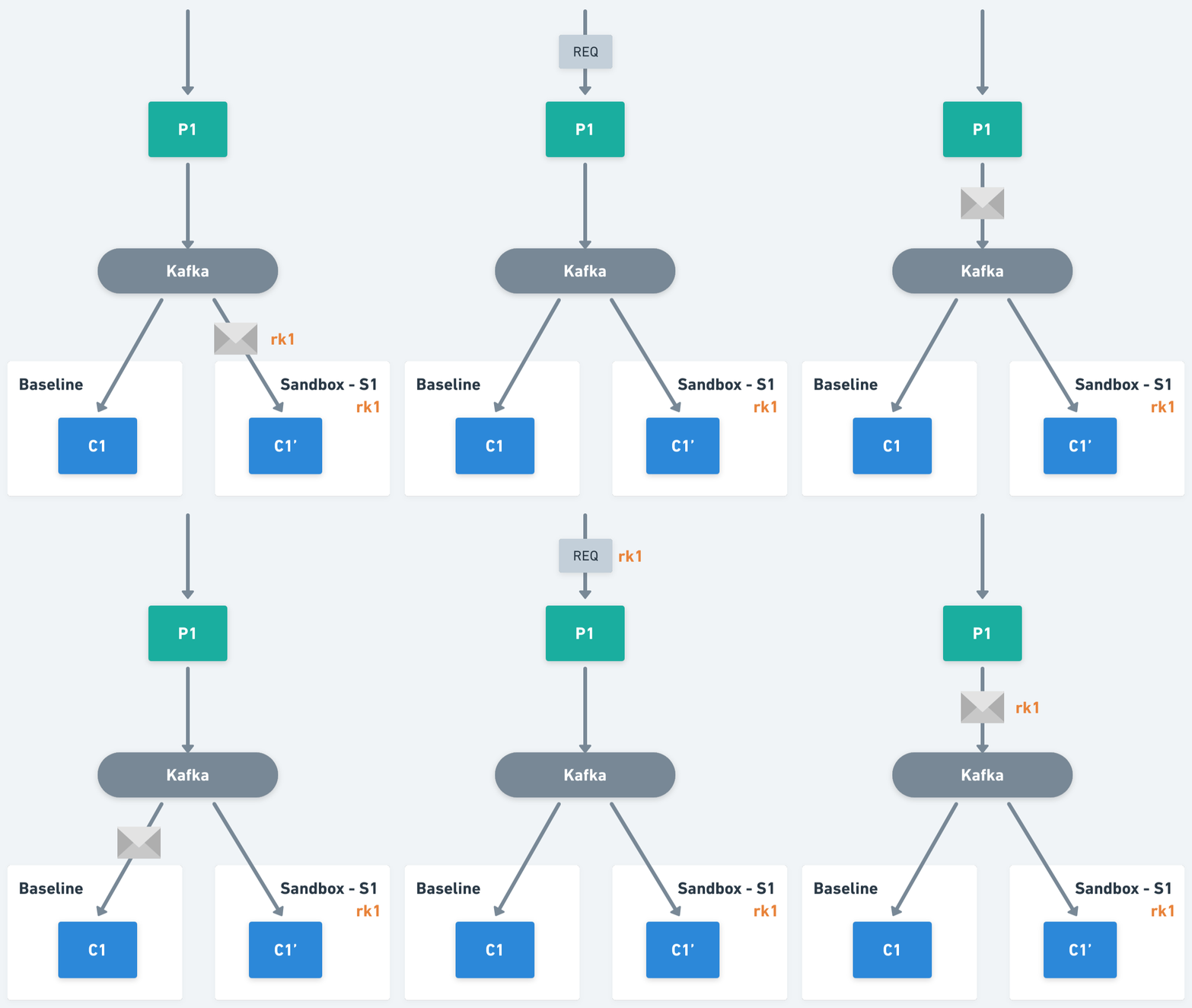
3. Resolve routing keys against a central Routes API. The consumption check needs the current mapping between routing keys and sandboxes, and that mapping lives in one place. The Signadot Operator serves it inside the cluster through the Routes API, a set of gRPC and REST endpoints that consumers can poll or stream and cache locally. Platform teams typically wrap the lookup and the consumption check in a small client library, so application teams get message isolation by importing it.
That is the whole model: one broker, one baseline environment, and any number of concurrent tests whose cost does not grow with the number of testers. For the full routing key contract and a complete Kafka implementation, see the complete guide to testing Kafka-based microservices.
Signadot spins up isolated sandboxes on the Kubernetes cluster you already run, so every change is validated against real services before it merges. The free tier is open to every developer.
How each event-driven pattern maps to the model
Event-driven systems are built from a handful of recurring patterns, and each one reduces to the same three mechanisms.
Pub/sub fan-out: one event, many subscribers
A checkout event fans out to payment, inventory, and notification services. Each subscribing service applies the consumption check independently, so you sandbox only the subscriber you changed: your test event reaches every subscriber, the sandboxed version of the one service under test processes it, and the baseline versions of every other subscriber handle it as usual. Because the routing key lives in the message rather than the transport path, fan-out needs no special handling at all.
Work queues and competing consumers
In a work queue, worker instances compete and exactly one takes each job. That guarantee normally comes from sharing a consumer group, which is precisely what sandboxed variants must not do. Instead, each variant (the baseline worker pool and each sandboxed worker) gets its own consumer group or subscription, so each variant observes every job, and the consumption check preserves the one-processor guarantee across variants: the matching variant processes the job, and the others skip it and acknowledge.
Multi-hop chains and choreographed sagas
Flows like order placed, then payment captured, then shipment created span several producer-consumer hops. The routing key must survive every hop, so each consumer copies the key from the message it processes into any requests or messages it emits, which is the same context propagation rule the synchronous half of the system already follows. When a change spans multiple services in the chain, a route group assigns one routing key to several sandboxes, so the whole modified path is exercised together while everything else stays baseline.
Flows that do not start with a request: CDC, cron, and batch
Change data capture pipelines and scheduled jobs have no incoming request to carry a routing key, so the key has to be established at the source. For CDC tools like Debezium, that usually means a metadata column in the source rows that the producer copies into message headers. For a cron job that reads rows and publishes them, the job tags each message according to the tenant the row belongs to. Batch processors add one more rule: group messages by routing context, so a single batch never mixes messages that belong to different sandboxes. Once the key is in the message, everything downstream works exactly as in the request-driven case.
The same model across brokers
The three mechanisms rely on broker features that are nearly universal: metadata attached to each message and a way for multiple consumer variants to observe the same stream. In Kafka that is headers and consumer groups; in RabbitMQ, headers and per-variant queues bound to the same exchange; in Google Pub/Sub, attributes and per-sandbox subscriptions; in SQS, message attributes. The primitives differ but the contract does not, and the broker-specific details are covered in testing microservices with message isolation for Kafka, SQS, and more.
Seeing it work
The fastest way to make this concrete is to run it. The complete Kafka guide includes a hands-on tutorial with a small demo application where you can watch each case live: a baseline message handled by the baseline consumer, a sandboxed consumer picking up only its own messages, an unmatched routing key falling through to the baseline, and a route group carrying a change through a forked producer and a forked consumer together.
Conclusion
Testing event-driven architectures does not require duplicating brokers, topics, or consumers per environment. Three mechanisms, a routing key propagated inside every message, a consumer-side check that decides which variant processes it, and a central Routes API that holds the mapping, are enough to give every developer and every pull request an isolated end-to-end test path through the real system. The model covers pub/sub fan-out, work queues, multi-hop sagas, and even flows that start in a database log or a cron job, and it works across Kafka, RabbitMQ, Pub/Sub, and SQS.
Signadot provides the pieces so you do not build them yourself: sandboxes with assigned routing keys, route groups for multi-service changes, and the Routes API served by the operator in your cluster. Sign up to try it on your own cluster, or start with the hands-on Kafka tutorial.
Frequently asked questions
How do you test event-driven architectures?
Test against a shared baseline environment instead of duplicating brokers and consumers for every test. Each change runs in a sandbox: messages triggered by a test carry the sandbox's routing key in their metadata, every consumer variant sees the message stream, and a small consumption check ensures exactly one variant processes each message. This gives isolated end-to-end tests across producers, the broker, and consumers on one shared infrastructure.
How does selective consumption decide which consumer processes a message?
Each sandboxed consumer processes only messages whose routing key belongs to it, meaning its own sandbox's key plus the keys of any route groups that include it. The baseline consumer processes messages that carry no routing key or a key no sandbox claims. Consumers make this decision locally against a cached copy of the routing-key mapping served by a central Routes API.
Does this approach work with brokers other than Kafka?
Yes. The model relies on two broker features that are nearly universal: message metadata (headers or attributes) to carry the routing key, and a way for each consumer variant to see the message stream, such as consumer groups, subscriptions, or queue bindings. It applies to Kafka, RabbitMQ, Google Pub/Sub, AWS SQS, and similar systems.
How do you test event-driven flows that do not start with a request, like CDC or cron jobs?
There is no incoming request to carry the routing key, so embed the routing metadata at the source instead: a metadata column that the CDC producer copies into message headers, or per-tenant tagging in the job that generates the messages. Once the key is in the message, the same selective consumption applies downstream.