Signadot Skills move high-fidelity, infrastructure-backed validation directly into the coding agent's inner loop, giving agents the ability to test their own work against live services before a PR is ever opened.
Coding agents like Claude Code and Cursor can refactor a microservice in seconds. But they cannot see how that change behaves when it hits the rest of your system. They lack the context to observe side effects, verify downstream dependencies, or confirm service health in a live environment.
For teams building on microservices, this is the core bottleneck. The real challenge is no longer the speed of writing code. It is the speed of verifying it. And as agents accelerate PR volume, the gap between generation and validation is widening fast.
Today, we are announcing the Signadot Skills framework to close that gap. Skills move high-fidelity, infrastructure-backed validation directly into the agent’s inner loop, giving coding agents the ability to test their own work against live services before a PR is ever opened.
Most agents stick to what they can do locally on the machine. While this handles basic runtime validation, it leaves a gap where complex integration issues occur later in the lifecycle.
To bridge this gap, an agent needs the ability to:
The Signadot Skills framework provides the Actions that allow agents to interact with live Sandboxes and RouteGroups.
Skills are built on three layers that separate platform governance from developer flexibility.
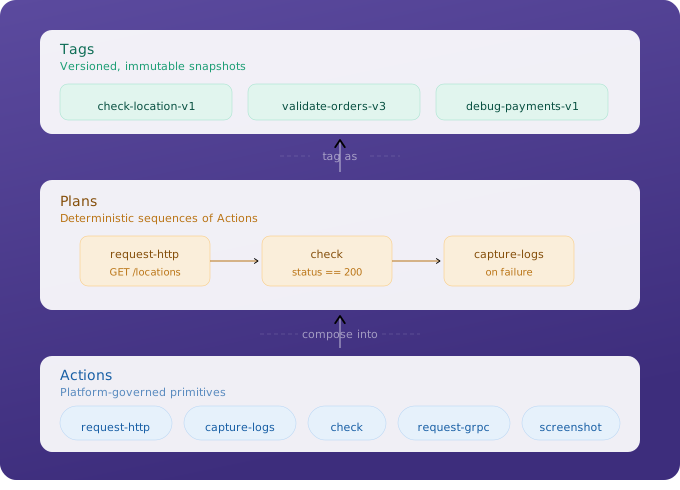
Actions are platform-supported primitives like request-http, check, etc. These are governed by platform engineering and run on Runner Groups managed via the Signadot API. We are starting with a core set of actions and allowing users to contribute more to the signadot/actions repository. These ship with a default image capable of running most built-in actions.
We will be launching with a core set of built-in Actions and will open the signadot/actions repository for community contributions in the future.
A Plan is a deterministic sequence of Actions generated from a prompt. You can author these prompts from your coding agent, the CLI, or the Signadot UI.
Prompt-Driven Authoring: You can create a new capability by describing it to your agent:
Signadot generates a transparent DAG for you to review and test with inputs like $ENDPOINT before finalizing.
Once a Plan is stable, you tag it with a version like check-location-service-v1. Tags work like Docker tags: they pin a specific, immutable snapshot of your validation logic so that your agent always invokes exactly the sequence you approved.
Signadot Skills are versioned capabilities backed by hardened platform infrastructure. By tagging and exporting these plans, you provide your agent with a secure gateway to execute complex validation logic against your live environment.
A generated .claude/SKILL.md looks like this:
---
name: check-location-service
description: Validates the location service endpoint in a specific sandbox.
---

Run the following command using the Bash tool:
signadot plan run check-location-service-v1 --set endpoint=$ENDPOINT --set sandbox=$SANDBOX

Summarize results. If it fails, analyze the error and propose a fix.You can now ask an agent to verify its own work during a refactor, collapsing functions that traditionally only lived in CI into the early development phase.
The developer receives not just a code change, but a verified result. The agent closed the loop.
We think Skills will have a major impact on how platform teams support developers in the age of coding agents.
Instead of shipping only CI pipelines that run after the fact, platform teams can now ship validation capabilities directly to developers and their agents. These capabilities run against real infrastructure, produce deterministic results, and are governed at the platform level.
With Skills, we are moving from agents that write code to agents that build and validate systems.
Skills is launching in early Q2, 2026. If you are interested in learning more about Skills, schedule a demo call below or come talk to us on Slack. Subscribe to our newsletter to stay updated on the release.
Get the latest updates from Signadot