This tutorial shows how to quickly test new Temporal worker code using Signadot Sandboxes in Kubernetes without redeploying the full stack. It covers deploying baseline services, routing workflows to sandboxed workers, and explains how context propagation, selective task execution, and routing key propagation into activities enable safe, isolated testing with both Python and TypeScript workers.
Co-authored by Arjun Iyer and Nimesha Jinarajadasa.
Welcome to the Temporal + Signadot Sandboxes tutorial! In this guide, you’ll learn how to quickly test new versions of Temporal worker code, either in a pull request or during local development, by leveraging a Temporal setup running in a remote Kubernetes cluster. This setup enables you to:
Estimated time to complete: 10-15 minutes
What you’ll accomplish:
Before you begin, ensure you have the following prerequisites set up:
1) Docker Desktop with Kubernetes Enabled
2) kubectl Installed
Set your context to the Docker Desktop Kubernetes cluster:
kubectl config use-context docker-desktop3) Signadot Account and Operator
4) Signadot CLI (Optional, but recommended for sandbox management)
brew tap signadot/tap
brew install signadot-cliFirst, clone the Signadot examples repository and navigate to the Temporal tutorial directory:
git clone https://github.com/signadot/examples.git
cd examples/temporal-tutorial
The example includes two worker implementations: a Python worker (temporal_worker/, built on temporalio 1.18.2) and a TypeScript worker (ts_worker/, built on @temporalio 1.19.0), both using OpenTelemetry 1.41.x for context propagation. This tutorial walks through the Python worker; the TypeScript worker gets its own section at the end.
Next, deploy the Temporal server components into your cluster:
kubectl create namespace temporal
kubectl apply -f k8s/temporal/Deploy the baseline worker and the client UI:
kubectl apply -f k8s/worker-deployment.yaml
kubectl apply -f k8s/temporal-py-client-ui-deployment.yaml
Verify the deployments:
kubectl get pods -n temporal
kubectl get services -n temporal
You should see something like the following for the pods:

And this for the services:

Open the client UI in your browser. If using a local cluster, port-forward:
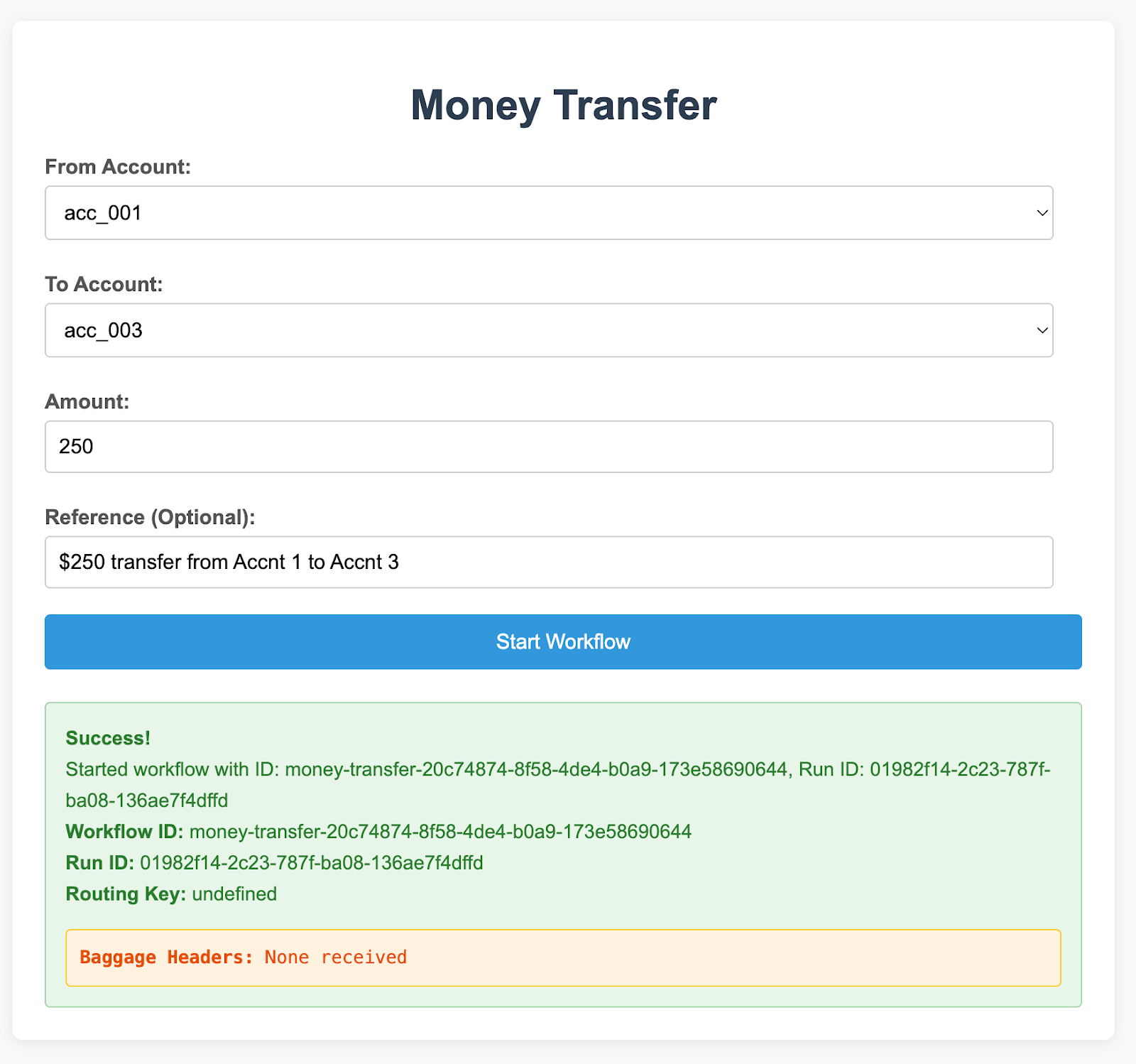
kubectl port-forward svc/temporal-py-client-ui 8080:8080 -n temporalThen visit http://localhost:8080, fill out the form, and submit a transfer. You should see a confirmation and workflow ID.
Next, port-forward the Temporal UI:
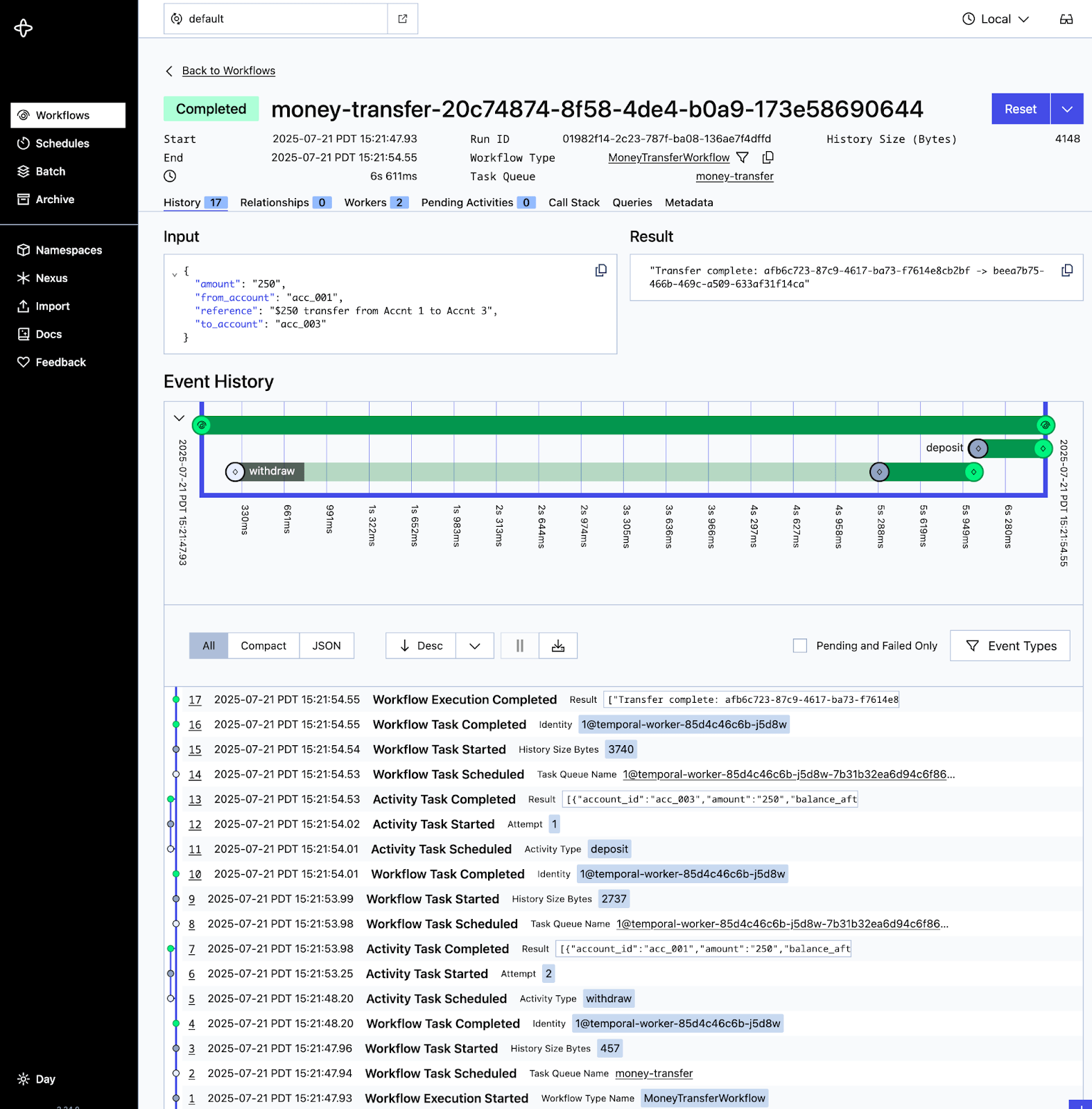
kubectl port-forward svc/temporal-ui-service 8088:80 -n temporalThen visit http://localhost:8088 and search for your workflow ID to inspect its execution.
You should see something like this in the worker logs:

Now fork the worker deployment into a sandbox. The provided sandbox spec (sandbox/worker-sandbox.yaml) forks the baseline worker deployment using the same image, so no code changes are needed:
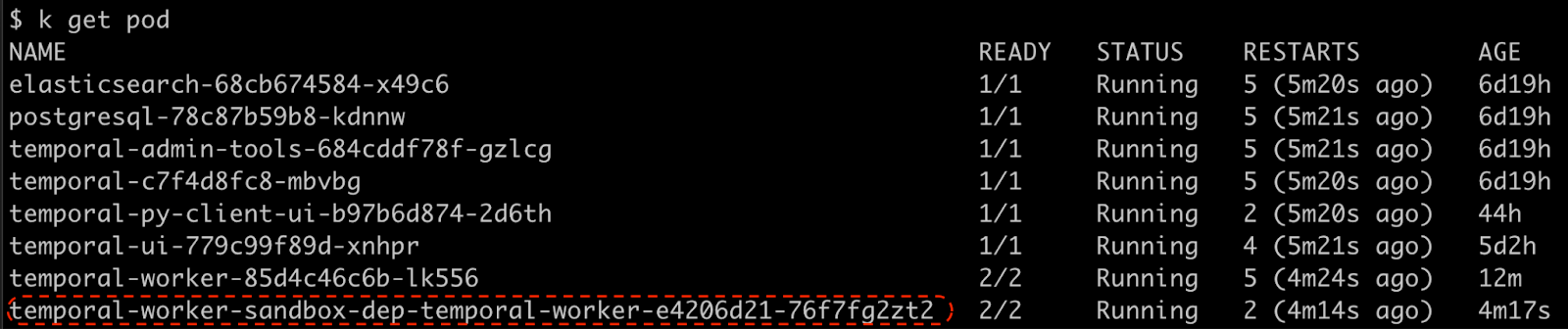
signadot sandbox apply -f sandbox/worker-sandbox.yaml --set cluster=<your-cluster>Once the sandbox is ready, confirm a new worker pod is running in the temporal namespace:
To route requests to the sandbox, use the Signadot Chrome Extension:
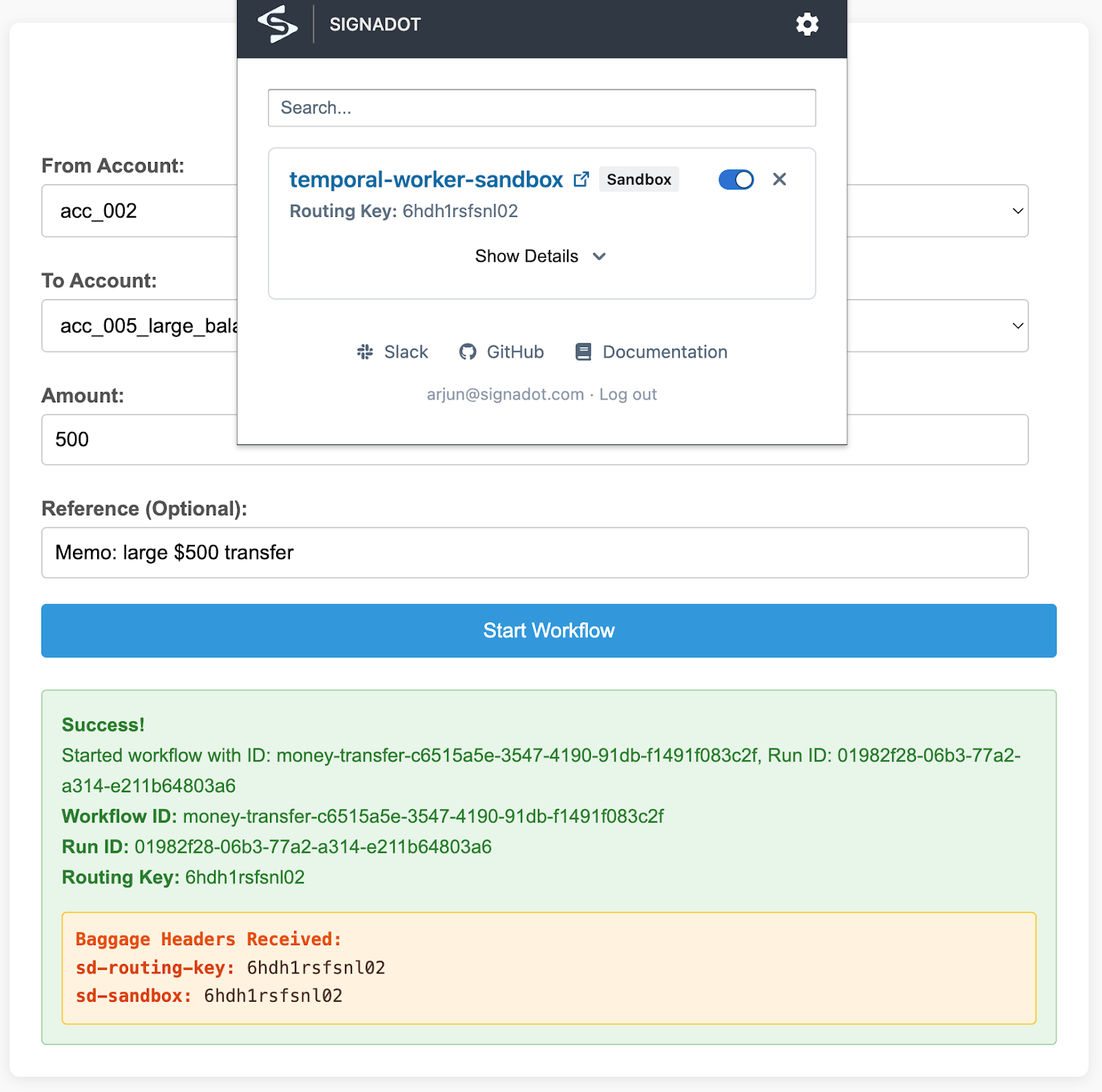
Watch the Temporal UI and both worker logs:
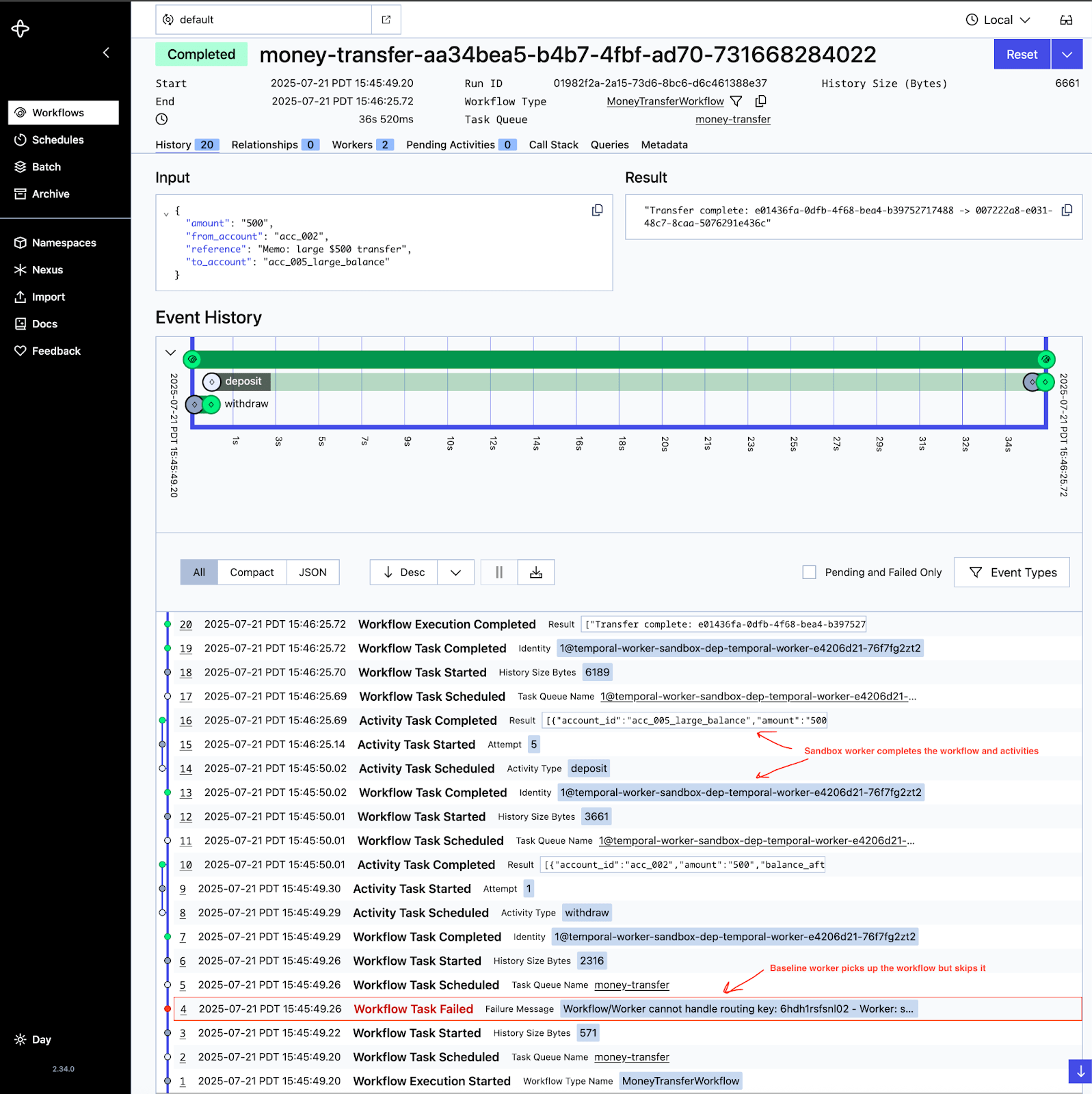
You may see the task initially picked up by a baseline worker, but it will eventually be processed by the sandbox worker (retries are visible in the Temporal UI).
TracingInterceptor to propagate OpenTelemetry baggage (including the Signadot routing key, sd-routing-key) into the workflow submission task. The serialized context is stored under the _tracer-data key in the workflow’s headers in Temporal’s persistent storage._tracer-data header format is the same across the Python, TypeScript, and Java SDKs, so clients and workers can mix SDKs freely.temporal_worker/signadot/interceptors.py) read the routing key from the task headers and consult the Signadot routeserver (with a periodically refreshed cache) to determine if the worker should process the task.Accepting or rejecting tasks by routing key is only half the story. Activity code often makes outbound HTTP calls to other services, and those calls must also carry the routing key so Signadot can route them to the right sandboxes downstream.
Here’s the subtle part: the Temporal SDK’s tracing interceptor attaches the OTel context from the task headers around workflow execution, but for activities it only uses that context to parent the activity span. The baggage that carries sd-routing-key is not active while your activity code runs. Without extra work, an outbound HTTP call made from an activity carries traceparent but no baggage, and downstream sandbox routing silently breaks.
The worker’s SelectiveTaskInterceptor closes that gap: after the routing check passes, it extracts the context from the _tracer-data task header and attaches the baggage to the current OTel context, scoped to each activity execution. The worker auto-instruments aiohttp, so outbound HTTP calls made from activities automatically carry baggage: sd-routing-key=....
The Java SDK has the same behavior, and the same fix applies: bridge the baggage in an ActivityInboundCallsInterceptor using Baggage.makeCurrent(), scoped to the activity call. See temporal_worker/README.md in the example repository for details.
The example includes a second worker (ts_worker/) that implements the same routing pattern with the Temporal TypeScript SDK. From a tutorial standpoint, nothing new is required: the TypeScript worker has its own task queue (money-transfer-ts), its own deployment manifest, and its own sandbox spec (ts-worker-sandbox.yaml), and the steps above work the same way. All Temporal SDKs store the OTel context under the same _tracer-data header, so workflows started by the Python client are routed and processed correctly by the TypeScript worker, and vice versa.
What makes it worth a closer look is how the routing pattern is implemented, because the Python design does not port directly.
The TypeScript SDK runs workflow code, including workflow interceptors, inside a deterministic V8 isolate: no I/O, no Node.js APIs, and no access to the worker process’s memory. That is how the SDK guarantees deterministic replay, but it also means a workflow interceptor cannot query the routeserver or read a routing cache the way the Python interceptor does. The TypeScript worker splits the routing check across the two runtimes instead.
Inside the isolate, a workflow interceptor reads the routing key from the _tracer-data header using a pure string parse (no OTel runtime in the isolate). It then delegates the routing decision to a signadotShouldProcess local activity. Local activities are the sanctioned escape hatch here: they run on the Node.js side of the same worker process that is executing the workflow task, with full access to that worker’s routeserver-backed cache. A regular activity would be dispatched through the Temporal server and could be picked up by any worker, so the answer to “should I process this?” could come from the wrong worker’s cache.
The local activity’s result is recorded in workflow history as a marker event, which keeps replay deterministic. If the baseline worker later takes over a workflow that a sandbox worker started (for example, after the sandbox is deleted), replay sees the recorded result instead of re-running the check.
When the task is not for this worker, the interceptor throws a plain Error. In the TypeScript SDK, an error that is not a TemporalFailure fails the workflow task rather than the workflow, so the server retries the task until a matching worker picks it up: the same polling-based distribution the Python worker relies on. Commands from the failed task, including the marker, are discarded, so the next worker runs its own check.
The _tracer-data header is copied verbatim onto the activities, child workflows, and everything else the workflow schedules, via a custom outbound interceptor. This is deliberately a deterministic payload copy rather than the OTel SDK’s propagator machinery: workflow isolates are reused across workflow runs (reuseV8Context), and the OTel SDK holds mutable module state that would make runs and replays diverge.
On the Node.js side, an activity interceptor runs with no determinism constraints. It performs the routing check for activity tasks (local activities are exempt, since they already run on the worker that passed the workflow-level check) and restores the OTel context, including baggage, around activity execution. This closes the same gap the Python worker closes, so outbound HTTP calls made from activities carry the routing key downstream.
All of the Signadot-specific machinery in both workers lives in a platform-owned layer: the signadot/ package in the Python worker (worker.py, interceptors.py, routing.py) and src/signadot/ in the TypeScript worker. Application workflows, activities, and models contain no Signadot or OpenTelemetry code at all. The only integration point is constructing the platform’s SandboxAwareWorker in the entry point and handing it your workflows and activities.
In this tutorial, you learned how to use Temporal and Signadot Sandboxes to rapidly test new worker code in an isolated Kubernetes environment. We demonstrated deploying baseline services, submitting and routing workflows, and leveraging sandboxes for safe, high-fidelity testing without disrupting the baseline environment. Under the hood, interceptors route each task to the right worker version, and OTel baggage bridging keeps the routing key on outbound calls made from activities. The same pattern is implemented in both Python and TypeScript workers, with all Signadot-specific machinery isolated in a platform-owned layer so application code stays untouched. This approach enables faster iteration and more reliable integration testing for microservices.
Ready to go further? Check out more tutorials and resources at https://www.signadot.com/docs/overview.
Get the latest updates from Signadot